What 23,000 hours of R&D actually buys
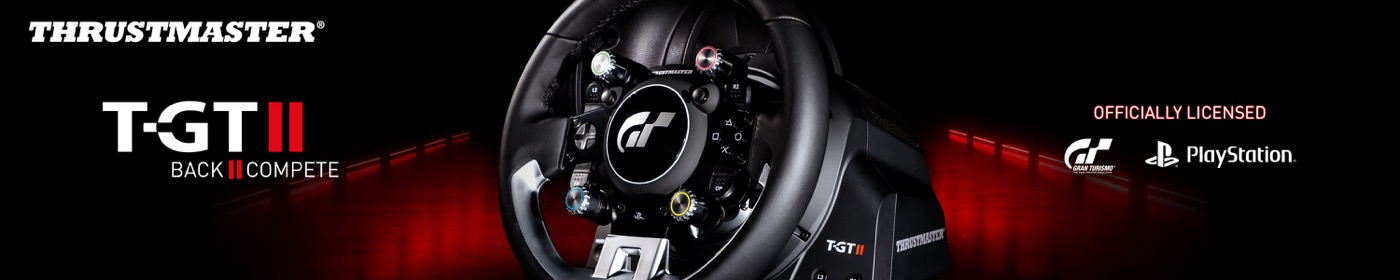
Most racing wheels are hardware products. The T-GT II is closer to a joint research project: more than 23,000 hours of development, much of it alongside Polyphony Digital — the studio that makes Gran Turismo — refining how force feedback should feel rather than how strong it should be. The result is the most technologically dense belt-drive wheel ever shipped, officially licensed for both PlayStation 5 and Gran Turismo — a double licence no other wheel carries.
Physically it's a leather-wrapped 25-button rim with four rotary selectors on the face, sitting on a base whose printed circuit boards are AEC-Q certified — the qualification standard of the actual automotive industry, chosen because competitive sim racers use this gear as a work tool through training sessions that would cook consumer electronics.
The 40-watt motor and the power plant behind it
The T-GT II's motor (Thrustmaster calls it the T-40VE) is the strongest belt-drive unit the company makes: 40 watts of perfectly linear output with the dynamic torque — velocity, in their vocabulary — to snap from a long steady-state corner load to a violent kerb strike without smearing the two together. Feeding it is the T-Turbo external power supply, a toroidal unit delivering constant power with 400-watt peaks for the moments a game demands everything at once: power drifts, chicane sequences, the instant of a crash.
On the rig, the practical translation is headroom. Where the T300 compresses the loudest effects at maximum force, the T-GT II keeps rendering detail on top of full load. Long sessions don't fade it either — the motor's embedded cooling system (T-M.C.E.) moves heat out of the windings rather than letting output droop, which our three-hour GT7 endurance stints confirmed.
The technology stack, decoded
Thrustmaster's spec sheet for this wheel is an alphabet of proprietary systems. Three genuinely change the driving:
- T-RTF (Real Time Force): a processor in the base computes feedback effects in real time instead of waiting on the game — no dead zones, no latency hiccups, in every title on console and PC.
- T-DFB (Depth Feedback): the Polyphony collaboration's signature — a 3D layer over standard force feedback expressing tyre adherence in under/oversteer, mass transfer, road texture and suspension. In GT7 it's the difference between feeling that you're sliding and feeling how.
- T-DCC (Drift Curve Calculation): real-time drift management that keeps wheel and car responsive mid-slide, so corrections land where you aim them.
The rest of the alphabet — T-LIN (100% linear force), T-F.O.C. (Hall-effect motor control), T-AEC-Q (the automotive boards) — amounts to one promise: what the game computes is what your hands receive, indefinitely. In GT7, with a title built to exploit these systems, the T-GT II simply has information other wheels don't carry.
GT-native controls
The four rotary selectors aren't decoration — Gran Turismo recognises them natively for differential braking, traction control, fuel mapping and torque management, the four settings you actually adjust mid-race. Turning brake bias with a physical dial while holding a line through 130R is the kind of interaction that makes returning to button menus feel primitive. The included T3PA-GT II pedal set is the familiar three-pedal starting point, and the base accepts the TH8A shifter, TSS handbrake and T-LCM pedals — plus the full add-on rim catalogue via quick release.
The honest paragraph
Here is the T-GT II's problem, stated plainly: it's a belt-drive wheel at a direct-drive price. AED 2,000+ now buys genuine direct drive, and on raw feel — peak force, ultimate detail — direct drive wins; our own T818 out-scores it there. The T-GT II's case rests entirely on what it does that direct drive doesn't: the Polyphony-exclusive depth effects, the GT-native controls, the PS5 licence, the turnkey completeness (pedals included, no rim to buy). Inside Gran Turismo, that case holds. Outside it, the value score of 6.9 is us telling you the truth.
Who should buy it — and who shouldn't
Buy the T-GT II if…
- Gran Turismo is your discipline and you want its definitive wheel
- You race PS5 competitively and need effects computed on-wheel, not in-game
- You want flagship performance with pedals in the box — no extra purchases
- Long training sessions demand automotive-grade internals
Skip it if…
- You spread time across many sims — the T300 gives most of this for half
- You're PC-only — the T818's direct drive is the better flagship there
- Value-per-dirham is the deciding metric (see: 6.9)
- You're new to wheels — start at T248/T300 and grow into this tier
Where to buy in the UAE & KSA
Prices are indicative ranges from our last check — the retailer page is always the source of truth. We earn a disclosed commission on these links at no extra cost to you.
FAQ
What makes the T-GT II special for Gran Turismo?
It was co-developed with Polyphony Digital: its T-DFB depth feedback renders effects GT7 sends that other wheels can’t express — tyre adherence, mass transfer, road texture — and its four rotary selectors map natively to GT’s differential, traction, fuel and torque settings.
Does the T-GT II work on PC?
Yes — alongside its PS5/PS4 licence it runs on PC with full driver support. But on PC-only budgets this money is better spent on the direct-drive T818.
Is it stronger than the T300?
Meaningfully: 40 watts vs ~25, with a 400 W peak power supply behind it. It’s not just louder force — the T-RTF processor computes effects in real time on the wheel, so response stays sharp in every title.
T-GT II or T818?
Different answers to different questions. GT7 on PS5: T-GT II — the T818 doesn’t speak PlayStation. Maximum raw feel on PC: T818’s direct drive wins. Both are flagships; your platform decides.
Why is the value score only 6.9?
Because AED 2,000+ overlaps direct-drive territory, and outside Gran Turismo the T-GT II’s unique features matter less. Inside GT7 the price is defensible; as a general-purpose wheel it isn’t the efficient spend.